

Perspectives of Cognitive Development and Perception of Reality of Our Stone Age Ancestors -Giriraj Kumar
Abstract: Rock art is a form of folklore expressed on the bare surface of rocks mostly by our Stone Age ancestors. It is an important source for understanding the cognitive, intellectual and cultural development of the early humans. Indian rock art is extremely rich and varied in forms, motifs, styles and themes executed both in the form of paintings and petroglyphs, many times on the same surface one above the other overlapping or concealing the earlier ones. It presents clearly defined developmental traits, patterns and perception of reality in the dynamic process of the creative history of humankind right from the early Stone Age till a few centuries back. Besides, rock art and rock art sites are the best testimonies of the unending human quest for unravelling the secrets of the nature and finding the truth, and also that of human spirit of passion, adventure and creativity. These are the timeless human qualities needed by any society at any time to progress and live a meaningful quality life.
Introduction
Rock art is a form of folklore expressed on the bare surface of rocks mostly by our Stone Age ancestors. The present paper is to explore the cognitive development and perception of reality of our Stone Age ancestors, the Indian culture, through the palaeoart. It is also to understand how we have become humans, the most dominating species on the planet earth.
Indian Culture
Culture is the philosophy of life which we have developed collectively in the process of harmonizing with the Nature and realizing the Reality, the
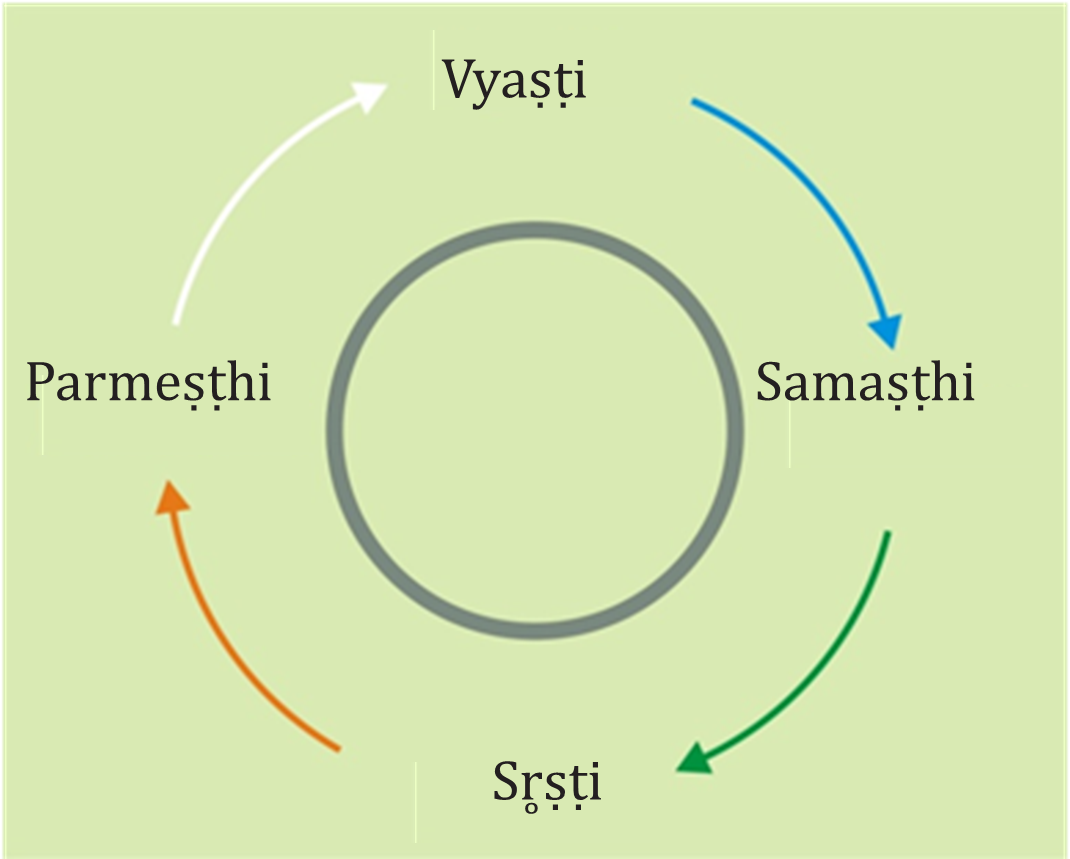
akṣara brahma (the Absolute Truth). Indian culture has been developed in the long period of our cognitive development and humanization right from the beginning of Stone Age which is evident from the study of rock art, archaeology and literature. It has been a long process of understanding and realizing the self (vyaṣṭi) in relationship with the society and the world (samaṣṭhi), the Nature (sr̥ṣṭi: jaḍa jagat and cetana jagat) and the all-encompassing Supreme Power (parmeṣṭhi) and again the self. It is the circle of the human quest for realization of the akṣara brahma When it is completed, the self becomes enlightened. Only adventurous and creative persons with a mission of life can achieve it. Others become followers of such enlightened persons. Rock art and rock art sites are the best testimonies of this unending human quest for unravelling the secrets of nature and finding the truth, and also that of human spirit of passion, adventure and creativity (Kumar 2014, 2015).
Rock Art
Rock art is a global phenomenon and India is one of the three countries having the richest treasures of rock art in the world. Rock art is found in the rock shelters, caves and on boulders and rock surfaces in open throughout the length and breadth of the country. It occurs in the form of rock paintings (produced by additive technique) and petroglyphs (produced by deductive technique), however, mostly in the form of rock paintings executed in natural earthen pigments.
Pl. 11.1: The circle of realization the Ultimate Truth (the akṣara brahma)
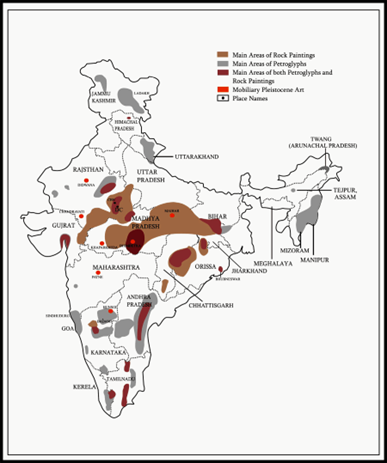
Pl. 11.2: Map showing the distribution of the palaeoart regions in India
What Do Rock Art Sites Mean to Us?
Mostly rock art sites are located in a serene environment where nature unfolds its wonders and beauty in the form of physical and natural creations such as oceans, canyons, gorges, hill valleys, caves, rock shelters, and a variety of flora, fauna, sweet-water streams and rivers in different geographic and climatic zones (Kumar 2014, 2015). A few good examples are Bhīmbeṭkā and some other sites.
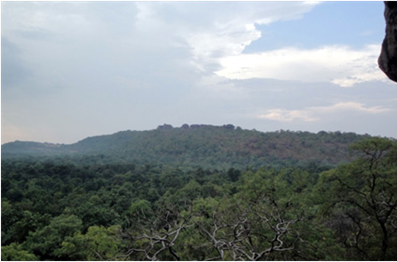
The serene beauty of lush green Bhīmbeṭkā, the World Heritage Rock Art Site forming a part of the Vindhyas in central India
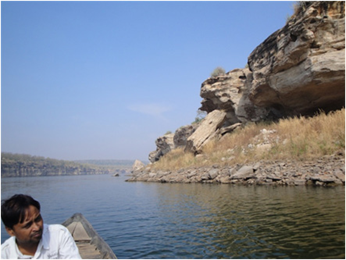
A big rock art site overlooking the deep gorge of River Chambal at Gandhisagar formed due to a major geological fault in the quartzite Vindhyan rocks
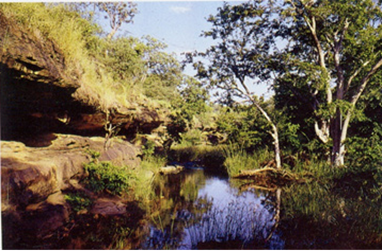
The wonderful Chaturbhujnath nālā carved by nature through the quartzite/orthoquartzite rocks in Chambal Valley having the longest rock art gallery in the world
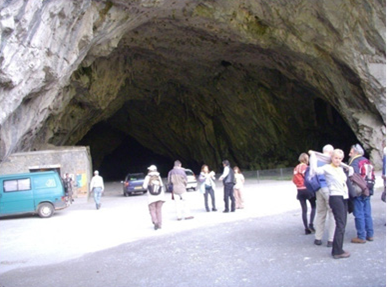
A huge and long Bedelhac’s Cave carved by nature in limestone in Ariege, France
Rock Art Sites Are One of the Best Testimonies of the Human Spirit of Adventure and Creativity
The varied forms of mother nature have always been the subject of curiosity and a great source of attraction for humans. At the same time, they have been posing a challenge to explore and fathom them. Only those having an adventurous and creative spirit and great passion to achieve the goal can meet this challenge. Thus, rock art sites are one of the best testimonies of this human spirit. When one visits such a rock art site, one imbibes nature’s splendour and imagines the dangers when the site was first explored hundreds of thousand years ago, one bows the head in appreciation of the pioneers’ spirit of adventure and creativity. Their great curiosity and passion and strong desire to unravel the secrets of nature made them bold enough to face all odds and meet the challenges coming in the way with great courage by using their creativity. Ultimately it is the human spirit which won and the early humans were able to explore such beautiful sites which were used by coming generations for hundreds of thousand years, in some cases even up to the present for their creative manifestations in the form of rock art (Kumar 2011, 2014, 2015). Some of them have been converted into lively temples which are worshipped even today, thus establishing the cultural continuity through the ages.
The Modern Construct of Human Cognition Might Have Developed During the Reign of Homo Erectus
Recently India has produced sufficient evidence both of mobiliary art like objects and rock art to understand the cognitive and creative abilities of Lower Palaeolithic hominins (Bednarik 1993, 1996, 2008, 2009, 2012; Bednarik and
Kumar 2012; Bednarik et al. 2005; Kumar 1995a, b, 1998, 2000-01, 2005, 2006, 2007; Kumar and Bednarik 2002; Kumar and Krishna 2014; Kumar and Pradhan 2008; Kumar 2005, 2006, 2008, 2012).
Lower Palaeolithic Art in India
The evidence of the Lower Palaeolithic palaeoart comes in the form of non-iconic petroglyphs obtained from the excavations carried out in the Auditorium Cave, Bhīmbeṭkā in the Vindhyas by V.S. Wakankar in the 1970s and at Darakī-Chaṭṭan in Chambal Basin by Giriraj Kumar during 2002-06.
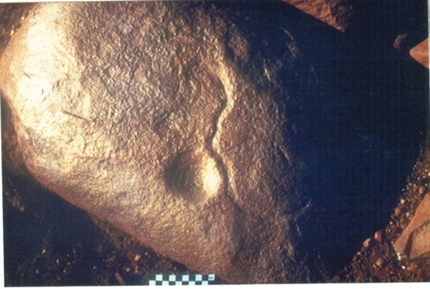
A deep cupule and a meandering line on a boulder exposed from Acheulian strata in the excavation of Wakankar’s trench in the Auditorium Cave, Bhīmbeṭkā in the 1970s. It was later recognized by Robert Bednarik in early 1990s
Setting of Darakī-Chaṭṭan Cave, a Palaeolithic cupule site, in the hard quartzite buttresses of Indragaṛh Hill in Chambal Basin
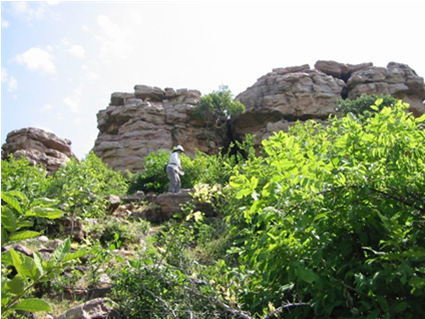
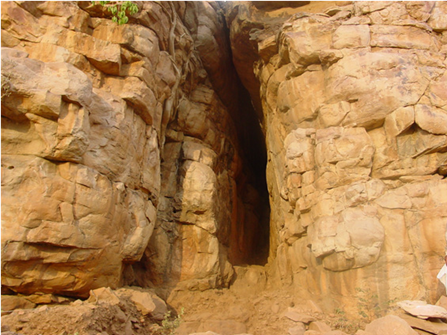
Darakī-Chaṭṭan Cave from the front
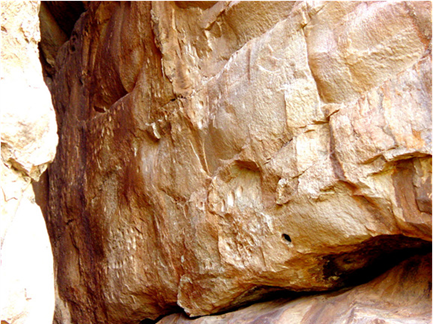
Southern wall of Darakī-Chaṭṭan Cave with front exfoliated
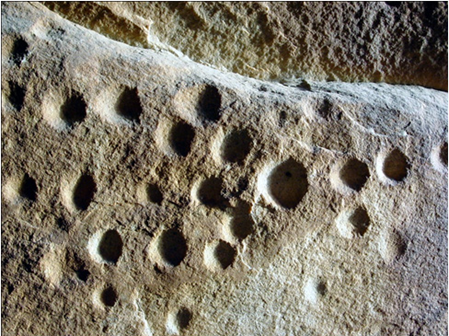
Palaeolithic cupules on the southern wall of Darakī-Chaṭṭan Cave
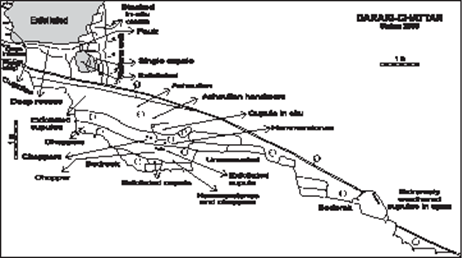
Schematic section of the excavations in Darakī-Chaṭṭan showing stratigraphic location of the exposed LP artefacts, exfoliated linear petroglyph, cupule slabs and hammer stones
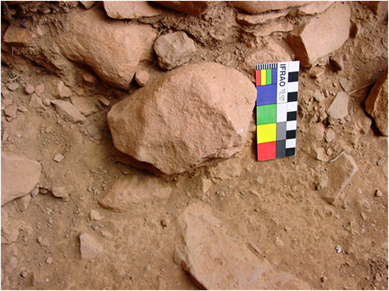
Oldowan type cobble tool in situ in pseudo-layer 5 exposed in the excavations at Darakī-Chaṭṭan. Lower Palaeolithic
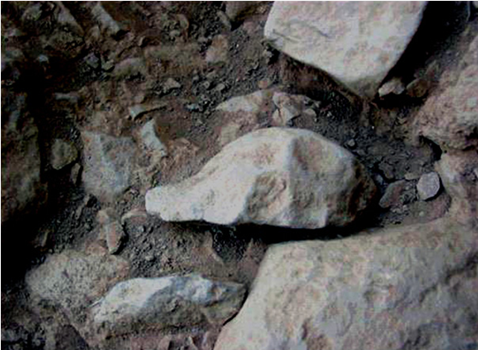
Acheulian small hand axe obtained from pseudo-layer 4 in the excavations at Darakī-Chaṭṭan
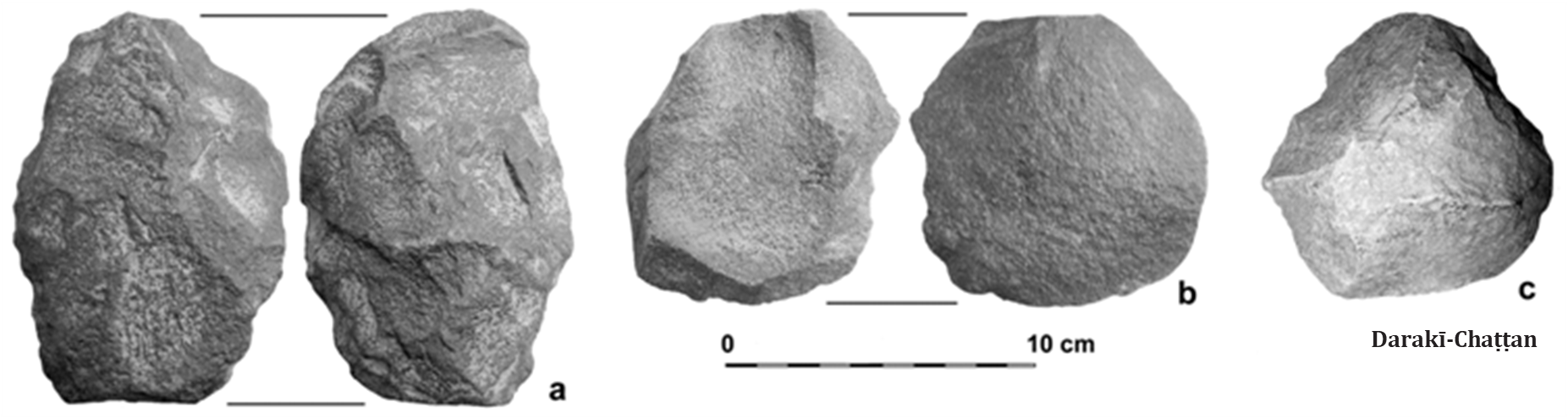
Acheulian hand axe and other artefacts obtained from pseudo-layer 3 in the excavations at Darakī-Chaṭṭan
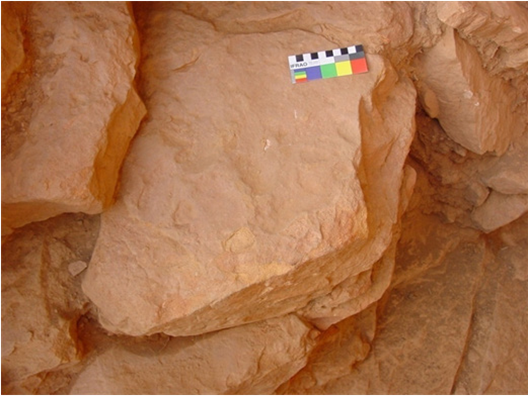
A slab bearing a broken elongated cupule coming from section facing south in layer 5, close to the bedrock at Darakī-Chaṭṭan, Lower Palaeolithic
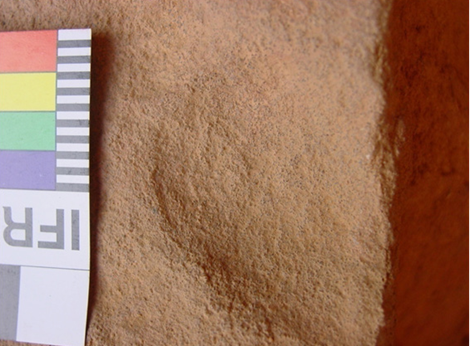
Right: close up of the same broken cupule
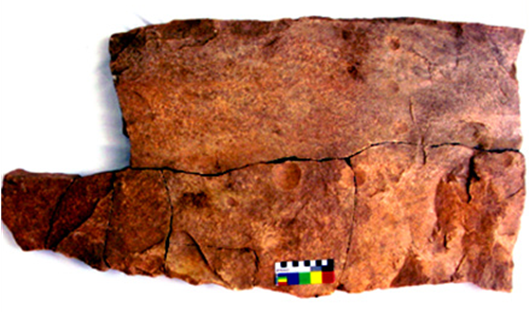
Slab pieces bearing cupules joined together, obtained from layer 3 (Acheulian) in the excavation at Darakī-Chaṭṭan
A very symmetrically shaped Acheulian disc from Maihar in district Satna, Madhya Pradesh (Pal 2005: 72-73). It is on quartzite, made with alternative flaking on its periphery.
The circular form is one of the universal forms. It was conceived and created in the form of circular discs by hominins of Acheulian cultures at Bhimbetka and Maihar. These non-utilitarian stone objects form one of the rare evidence of art-like activity of the Acheulian culture in India.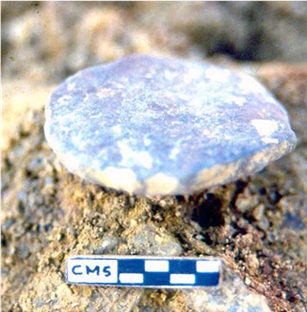
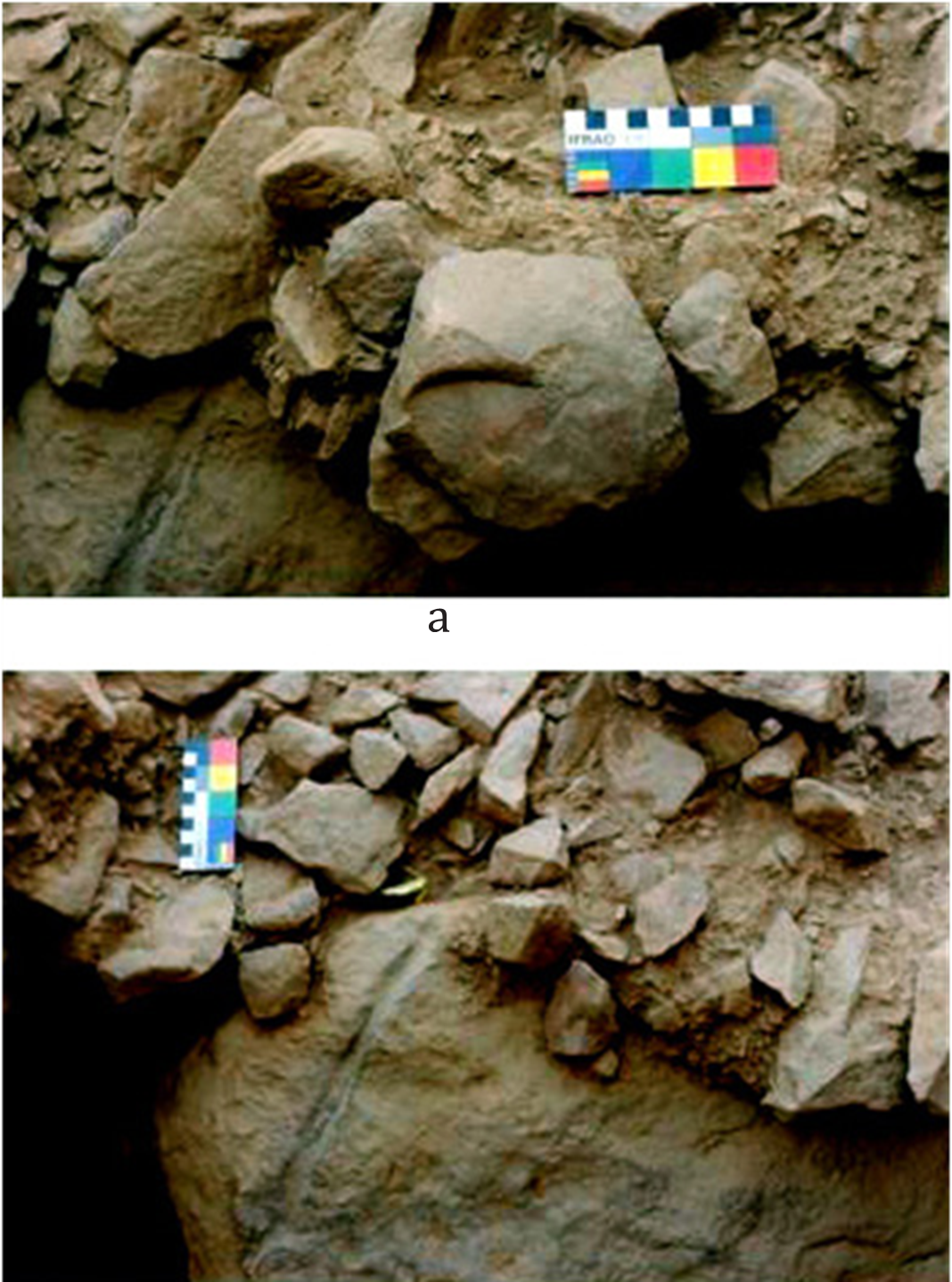
a-b: A slab bearing linear petroglyphs obtained from layer 3 (Acheulian) in the excavation at Darakī- Chaṭṭan
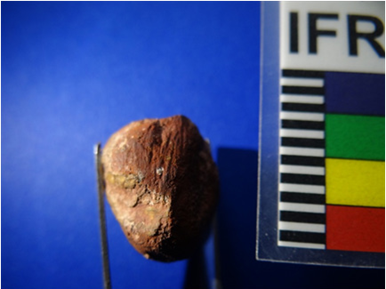
Haematite pigment with used striation marks obtained in the excavations from Acheulian levels at Hunsgi, Karnataka
Such iron pigments have been reported from different parts of the world and the oldest red ochre pigments, going back to 800,000 to 900,000 years, occur along with quartz crystals and coloured river pebbles in early Acheulian Wonderwork Cave site in South Africa (Bednarik 1993a: 61).
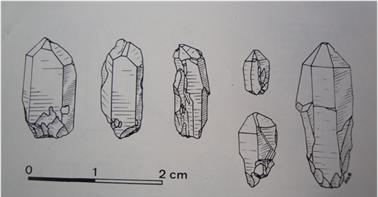
Tiny quartz crystals from Acheulian occupation site near Singi Talav, Diḍwānā, Rajasthan, collected by early man for their forms and visual qualities, after. Misra 1995)
The Global Perspectives
The Indian evidence of non-iconic Pleistocene art is consistent and in tune with the global evidence. Early evidences of art-like productions preceding the Upper Palaeolithic by hundreds of millennia from Morocco, Germany, England, France, Australia and other parts of the world were long know.
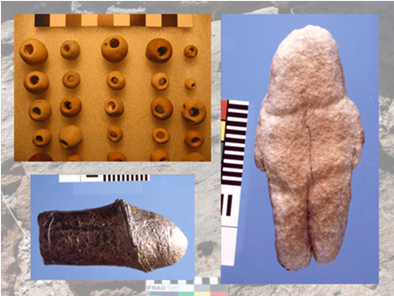
Lower and Middle Palaeolithic manuports, modified objects and beads from other parts of the world, clockwise from bottom left: Unmodified manuport of a cuttlefish fossil from the late Acheulian of Erfoud, Morocco, resembling a human penis, Acheulian stone beads from Bedford, England and a protosculpture of the Middle Acheulian from Tan-Tan, southern Morocco (courtesy Robert G. Bednarik)
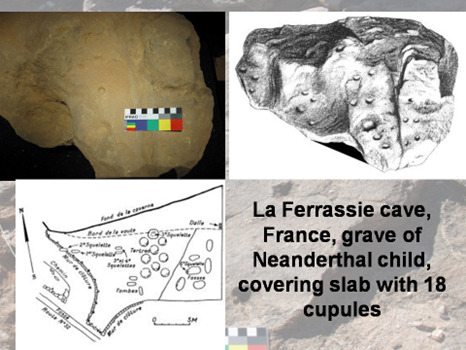
Middle Palaleolithic cupules from La Ferrassie Cave, France (courtesy Robert G. Bednarik).
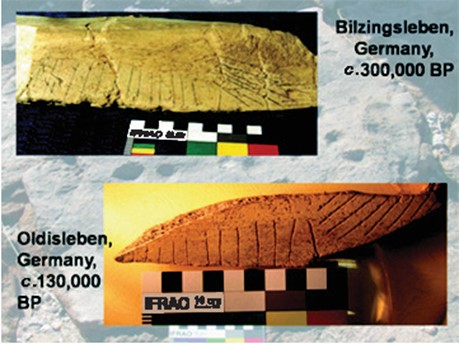
Lower and Middle Palaeolithic non-iconic art from Germany
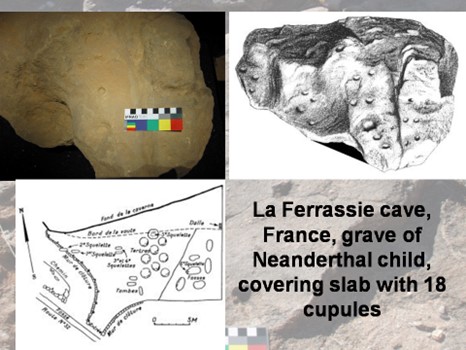
Middle Palaleolithic cupules from La Ferrassie Cave, France (courtesy Robert G. Bednarik).
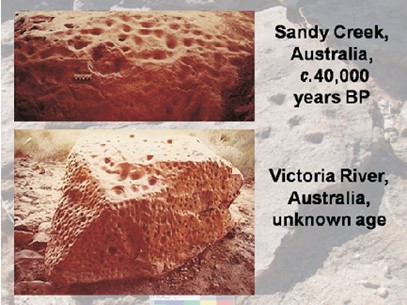
Early cupules from Australia
Replication of Cupules
For understanding the technology of the early cupules, we undertook replication project from 2002 to 2012 and produced almost all kinds of cupules present in Darakī-Chaṭṭan. We observed that it needs nearly 30,000 strokes with concentration and dedication in two days to create a small cupule. On the hard quartzite rock, every stroke rebounds with equal force. Our experiment of cupule replication indicates that cupule creation in Darakī-Chaṭṭan is not a play work. It must have been a serious task deeply related with life and undertaken with missionary zeal.
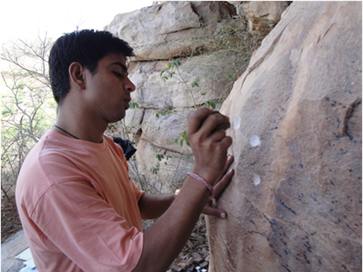
Ram Krishna on work to replicate cupules on hard quartzite rock by the southern side of Darakī-Chaṭṭan
Comments
Available evidence indicates that the Lower Palaeolithic people were intelligent and creative enough, and most probably the modern form of human cognition and symbolism might have developed during the reign of either Homo erectus or archaic Homo sapiens. But for a long time, scholars have been neglecting this fact because the evidence was contradicting the set model in which all art and art-like activities began with the coming of Aurignacian in Western Europe, about 33,000 to 35,000 years ago, which is not the case. The evidence from Bhīmbeṭkā and Darakī-Chaṭṭan through the EIP Project unambiguously established that the antiquity of rock art in India goes back to Lower Palaeolithic Age.
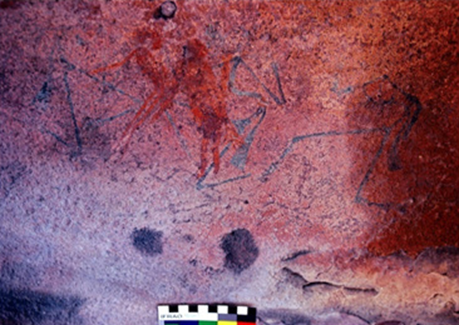
The green dynamic dancers from Bhonrawali Hill, Bhīmbeṭkā (Upper Palaeolithic)
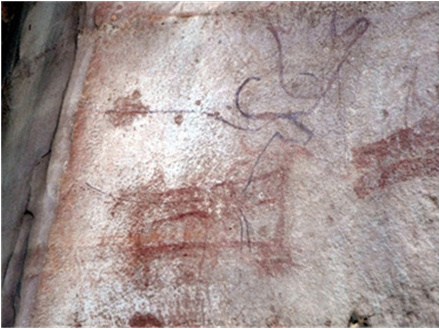
The bovid in green natural outlines from the Auditorium Cave, Bhīmbeṭkā (Upper Palaeolithic)
The Indian Acheulian has been shown, through the Thorium–Uranium dating method, to be generally beyond the limit of that method, which is around 350,000 BP (Mishra 1994: 63; Mishra et al. 1995, Chakravarty and Bednarik 1997: 59). These dates have been pushed back further to 670,000 BP by 39 Ar/40 K dating of Bori Tephra (Misra 1995); 1.2 Ma by ESR date from Isampur (Paddayya et al. 2002) and to 1.51 ± 07 Ma by 26 Al/10 Be dating of the artefacts at Attarampakkam in Tamil Nadu (Pappu et al. 2011: 1596-99).
It strongly supported the view that rock art is a global phenomenon and non-iconic rock art precedes the iconic Pleistocene art of the world. This latest evidence from Bhīmbeṭkā and Darakī-Chaṭṭan has shown that we have misjudged the time depth of palaeo art and human cognition, creative ability and symbolism. Now the time has come to change our mindset. The evidence is so important that it is set to affect not only our concepts of art origins and Pleistocene hominin development in southern Asia, but it will influence the way we view cognitive evolution generally.
Iconic rock art in India starts to occur mostly in the simple form of dynamic dancers and naturalistic forms of wild animals in Upper Palaeolithic in the terminal phase of Pleistocene period.
It was followed by explosion of creativity in Mesolithic in early Holocene period or even earlier than it. Numerous motifs, designs and animal, human and imaginative forms and symbols were created. The figures have been done mostly in gently flowing fine lines reflecting dynamic action, vitality
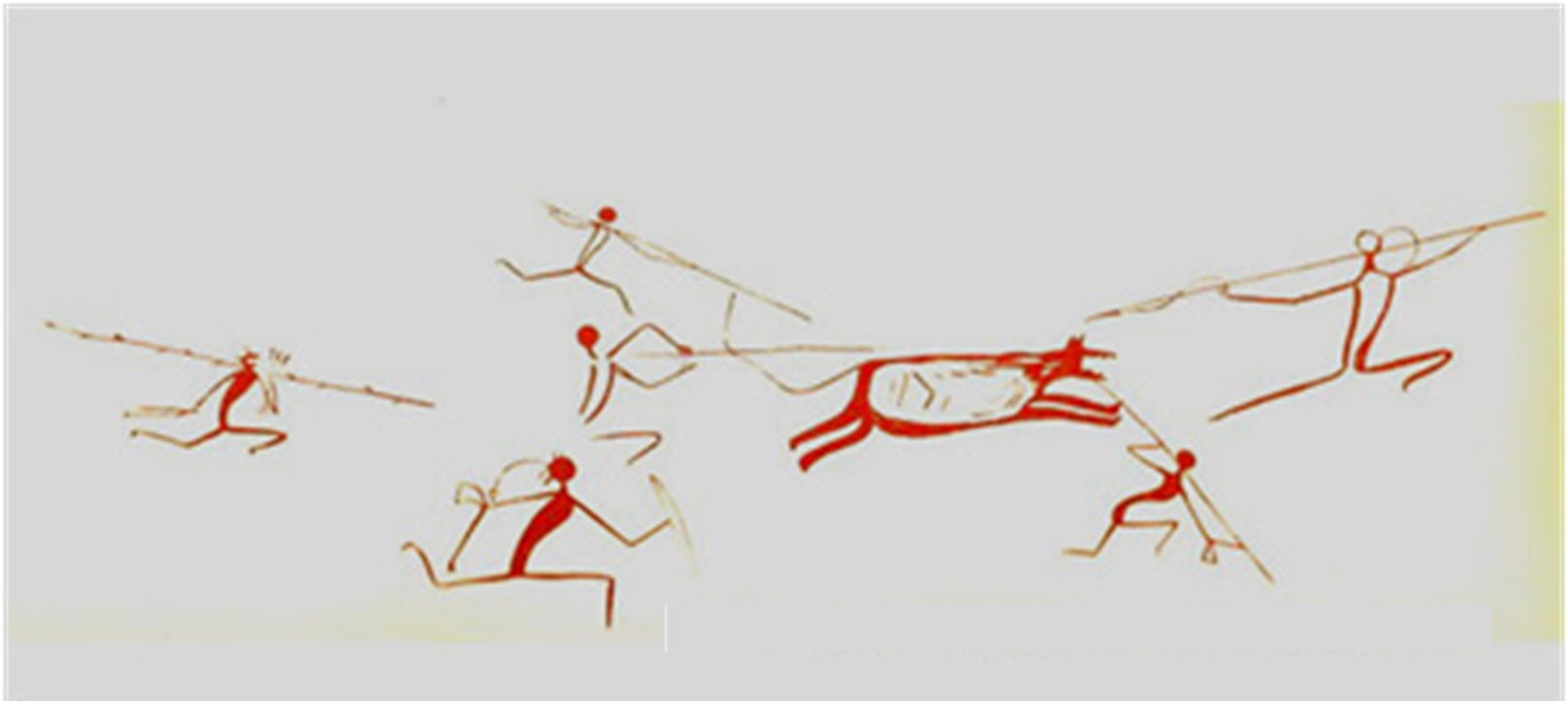
Dynamic scene of hunting a carnivore, Kathotia, Mesolithic, after E. Neumayer
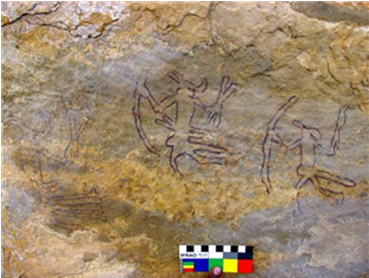

Running/dancing archers, Mesolithic, Chaturbhujnath nālā
Iconic rock art in India starts to occur mostly in the simple form of dynamic dancers and naturalistic forms of wild animals in Upper Palaeolithic in the terminal phase of Pleistocene period.
It was followed by explosion of creativity in Mesolithic in early Holocene period or even earlier than it. Numerous motifs, designs and animal, human and imaginative forms and symbols were created. The figures have been done mostly in gently flowing fine lines reflecting dynamic action, vitality in form and directness of visual perception, a keynote of the Mesolithic art (Wakankar 1978: 10, 2008: 65-72). The spectrum of Stone Age iconic rock art in India is wide and varied. It is unique up to some extent in terms of vigour and dynamism of figures, quality of lines, different styles and a wide range of themes (Pls 11.30-39) (Neumayer 1983; Mathpal 1984; Kumar 2014, 2015).
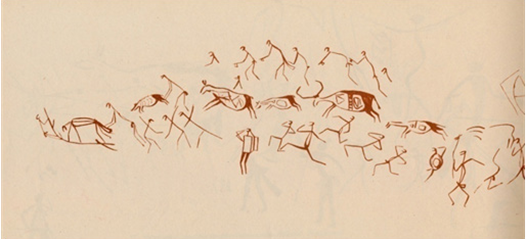
Celebration of life in the company of wild animals (group approx.300 cm), Lakhajoar, Mesolithic, after E. Neumayer
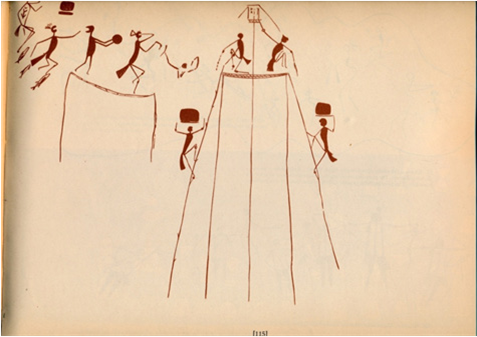
Celebration of life on a scaffolding, Lakhajoar, Mesolithic, after E. Neumayer
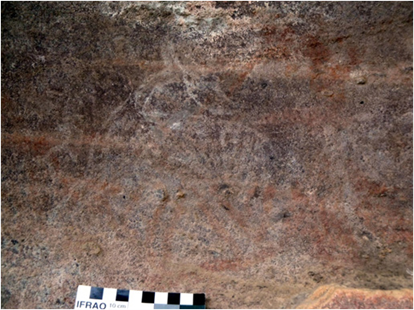
Hunted deer in deep pain, Bhīmbeṭkā, Mesolithic
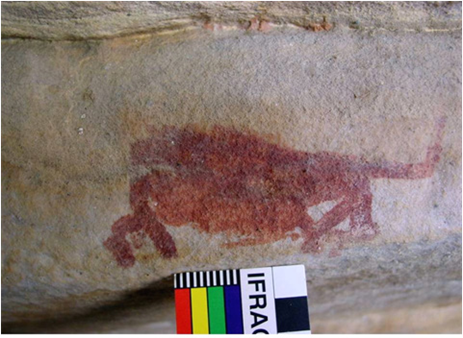
Lovemaking scene of a tiger couple, Chaturbhujnath nālā, Mesolithic
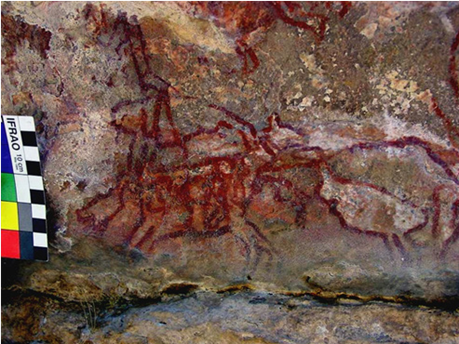
Vultures scavenging a dead animal, Chaturbhujnath nālā, Mesolithic
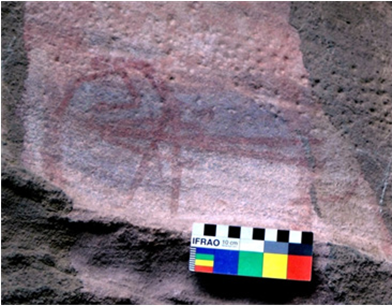
Pl. 11.37: Performance of an after death ritual ! Mesolithic. Bhimbetka.
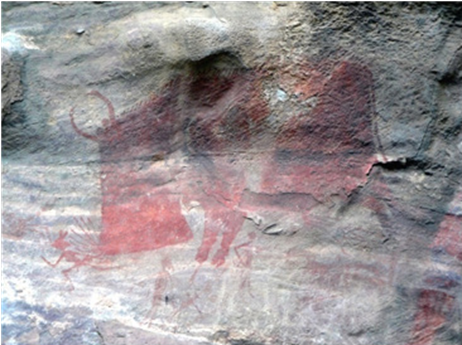
Deified composite animal (approx. 150 cm), Bhīmbeṭka, Mesolithic
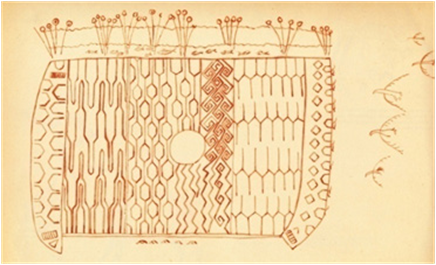
Perception and expression of the aquatic, terrestrial and areal world in a composite form, Mesolithic, Lakhajoar, after E. Neumayer
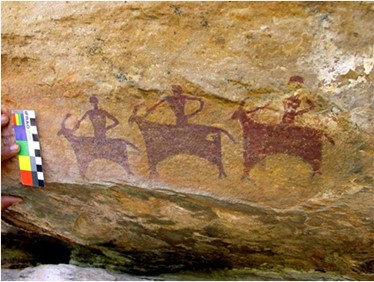
Beginning of cattle domestication with humpless cattle, Chaturbhujnath nālā, transition from Mesolithic hunting foraging to pastoral mode of life
Comments
Thus, through rock art, one can imbibe the dynamic and vibrant cultural life of the Mesolithic hunter-foragers and also different developmental traits, stages and later a distinct transition from hunting food gathering to cattle domestication life, especially in the Chambal Basin with humpless bull.
The creation of rock art continues till a few centuries back in Historic period.
The theme of the figures in rock art generally is not used to be a depiction of day-to-day life activities or sociocultural and natural environment as seen by their authors. Rather, it reflects the reality as perceived by their authors in particular and the related community in general, and also the huma behaviour developed in the light of so earned wisdom at different stages in human history.
Birth and death are two important realities of life understood by the humans and are associated with different kinds of ritual practices and ceremonies in different communities in different parts of the world. In between these two ends of birth and death, humans have been making their best efforts to sustain, maintain and celebrate life in a particular environment. In this process of struggle and celebration of life, they manifested their creative ideas and thoughts in the form of rock art and other media (Kumar 2009b). The former has survived to be studied and enjoyed by us.
Therefore, rock art is areflection of human mind, thought processes and efforts made for understanding the reality through the journey of development. It presents the human spirit of adventure and creativity, living life in harmony with nature, full of energy, enthusiasm and happiness, meeting the challenges with passion to overcome them, discoveries and inventions made, and philosophy of life developed in the process of harmonizing with nature. This philosophy matures in due course of time and in India it culminates in the form of Upaniṣads in later Vedic period.
Conclusion
Rock is one of the major sources for understanding the Cognitive Development and Perception of Reality of our Stone Age ancestors. It also helps us to understand how we have become humans. Both rock art and rock art sites have been a great source of motivation and inspiration for humans, right from the beginning and will continue to do so in future also. Thus, the rich rock art heritage reflects the very spirit of Indian culture and has given a unique identity to it. It also reveals that the secret of the cultural continuity of India lies in the unending human quest for understanding and living the truth. Only adventurous and creative persons with a mission of life can achieve it. Others become the followers of such pioneering persons. Rock art and rock art sites are the best testimonies of this unending human quest for unravelling the secrets of the nature and finding the truth, and also that of human spirit of passion, adventure and creativity. These are the timeless human qualities needed by any society at any time to progress and live a meaningful quality life.
Acknowledgements
All the innocent but intelligent villagers and scholars in India and abroad, discussions with whom helped me to understand the life a little bit in the process of rock art research and study of human past in the field, research centres and seminars since 1977.
My students of different Faculties of Dayalbagh Educational Institute, interactions with whom while teaching Indian culture helped me to understand and realize its depth.
My Australian friend Mr Robert G. Bednarik, Convener, International Federation of Rock Art Organisations (IFRAO) for providing me slides of Pleistocene art of overseas countries and to Mr. Erwin Neumayer from Austria from whose book I have used some of the copies of rock paintings.